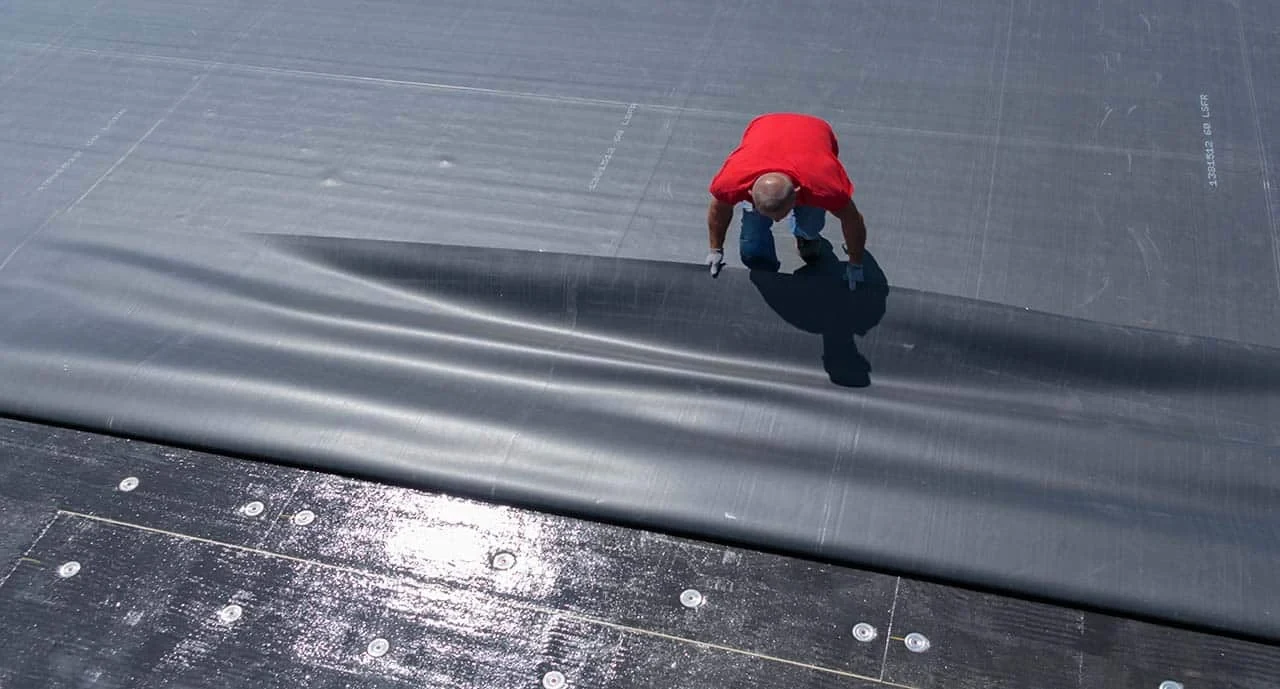
EPDM Roofs on Laredo's Older Commercial Buildings
A lot of the EPDM we work on in Laredo is already on the roof, installed years ago on a downtown office, retail strip, or older distribution building, and the question we get is not usually whether to install it new but whether to repair, recoat, or replace what is there.
Where EPDM Still Makes Sense
EPDM remains a durable, flexible membrane, especially in its white reflective version, and it still gets specified on some new low-slope roofs where budget and simplicity matter more than a fully adhered system. Its rubber composition handles the expansion and contraction that comes with Laredo's wide daily temperature swings, cool mornings into triple-digit afternoons, better than more rigid materials.
Where EPDM struggles here is the traditional black membrane version. Black EPDM absorbs heat aggressively under a Laredo sun, running roof surface temperatures well above ambient on a summer afternoon, which accelerates membrane aging and puts more load on any rooftop cooling equipment nearby. We see this most often on older warehouse roofs near Unitec and Killam that were built before reflective membrane became the default choice.
What We Find on Aging EPDM Roofs
Seam failure is the most common issue on EPDM roofs past a certain age, particularly on membranes installed with older adhesive-seam methods rather than newer tape systems. Seams open slowly at first, letting in small amounts of moisture that show up as interior staining long before the membrane itself looks compromised.
Shrinkage is the other issue specific to EPDM. As the membrane ages it can pull away from perimeter details, curbs, and penetrations, creating gaps at exactly the points where water is most likely to get in. On a roof with a lot of rooftop equipment penetrations, that shrinkage risk multiplies with every curb and pipe boot.
Repair, Recoat, or Replace
A dry, structurally sound EPDM roof with isolated seam issues is usually a repair candidate. We reseal or re-tape failed seams, replace worn pipe boots, and address perimeter shrinkage without touching the field membrane if it is still performing.
A roof with widespread seam failure but sound insulation underneath is often a recoat candidate, which extends service life without a full tear-off. A roof with wet insulation, deck damage, or membrane that has shrunk badly across multiple areas is a replacement conversation, and we document the moisture and deck findings so that recommendation rests on more than a judgment call.
- Downtown Laredo office and retail buildings with original EPDM still in place
- Older warehouse roofs in Unitec and Killam predating reflective membrane standards
- Roofs with isolated seam failure but dry, sound insulation underneath
- Buildings converting from black EPDM to a reflective recover system
- Government and municipal buildings with legacy EPDM roofs due for a condition review
Heat Load and the Case for Going White
When an EPDM roof is due for a recover or full replacement, the reflectivity conversation comes up quickly in Laredo. White EPDM or a switch to a reflective single-ply system reduces rooftop surface temperature meaningfully compared to black membrane, and on a building with rooftop HVAC or refrigeration equipment already working hard against the climate, that difference matters more here than it would in a milder region.
We do not push every building toward a membrane swap. Some owners are past the point where budget allows for anything beyond keeping the existing black EPDM watertight, and a well-sealed black roof is still a functional roof, just one that runs hotter and ages faster than the alternative.
Property managers overseeing several buildings across Unitec and Killam often ask about a standing maintenance program rather than reacting roof by roof after a leak call. A scheduled inspection each spring, before the heaviest summer heat arrives, and again once the hottest months pass, catches shrinkage and seam wear while it is still inexpensive to fix. That rhythm matters more on EPDM than on some other membranes, since seam and perimeter failures on this system tend to develop gradually rather than announce themselves with an obvious interior leak the first time something goes wrong.
Inspection and Documentation
EPDM roofs get walked seam by seam during an inspection, not scanned from the ground. We check adhesive and tape seams, perimeter flashing, pipe boots, and any areas where the membrane has visibly shrunk or pulled taut, and we photograph each issue against its location on the roof.
That documentation matters for storm claims too. Hail can bruise EPDM without puncturing it outright, and bruising is easy to miss without a close, methodical walk of the membrane. We record what we find in a form that holds up if the building files an insurance claim afterward.
EPDM Questions We Hear Most
Is black EPDM a problem in a climate this hot?
It runs hotter than reflective alternatives and ages faster as a result, though a well-maintained black EPDM roof can still perform for years. The bigger factor is how well the seams and flashing are holding up, more than the membrane color.
How do you tell if an EPDM seam has failed?
We probe seams by hand during inspection rather than relying on a visual check, since early seam separation often is not visible from a distance.
Can an EPDM roof be recoated instead of replaced?
Yes, if the insulation underneath is dry and the membrane is not badly shrunk. A recoat over a compromised substrate just delays the same problem.
Does hail damage EPDM differently than TPO?
EPDM can bruise under hail impact without an obvious puncture, which is why we check for soft spots and impact marks specifically rather than just looking for visible tears.
What is the biggest risk on an aging EPDM roof?
Shrinkage pulling the membrane away from curbs, perimeters, and penetrations, since that opens gaps at the roof's most vulnerable points.